
Checking Criminal History in Clinton County
No single Clinton County criminal record search answers every question. Begin with the office that created the item. The 65A District Court holds misdemeanors and the early stages of felonies. A felony that is bound over moves to the 29th Circuit Court. The Clinton County Sheriff holds sheriff reports, booking material, and county jail records. Michigan State Police maintains the statewide criminal-history repository, while the Michigan Department of Corrections tracks state custody and supervision. A full name, date of birth, possible prior names, incident date, and case number make each search more precise.
Use the official channel that fits the needed proof. A portal result is useful for finding a case, but a certified judgment must come from the clerk. A jail inquiry answers present custody, not the final outcome. ICHAT supplies the public part of reportable Michigan history by name, yet it does not show warrants, federal cases, tribal matters, traffic records, juvenile files, local misdemeanors, or out-of-state events.
- Identify whether the question concerns a police event, jail stay, court case, or statewide record.
- Search MiCOURT for 65A District or 29th Circuit entries, using the complete case number when one is known.
- Ask the Clinton County Sheriff about current custody or sheriff-created reports.
- Use ICHAT for the public Michigan repository layer and OTIS for MDOC custody or supervision.
- Order the exact document from its custodian when a portal screen is not enough.
Four Clinton County Record Searches
MiCOURT, ICHAT, the county jail channel, and OTIS often show different results because each serves a different system. MiCOURT follows litigation. ICHAT follows reportable events sent to MSP. The jail channel follows local custody. OTIS follows MDOC prison, parole, or felony probation status. A person can appear in one source and not another without any source being wrong. Timing, court level, legal restrictions, and agency scope all shape the result.
| Channel | Best question | Main limit |
|---|---|---|
| MiCOURT | What was filed and how did the case move? | Participation and document images vary. |
| ICHAT | What public reportable Michigan history matches this name? | Name based and subject to exclusions. |
| County jail inquiry | Is the person now or recently in Clinton custody? | County custody only. |
| OTIS | Is the person in MDOC custody or supervision? | Not a county jail roster. |
The official Clinton County homepage shows the county departments that route these requests.
The department directory helps a reader choose a custodian before submitting a request.
Michigan Official Background Checks
The Michigan State Police Criminal Justice Information Center offers two very different self-review paths. ICHAT is a $10 public name search. It uses name, birth date, and other identifiers to return the public subset of Michigan repository data. Similar names can produce uncertain matches. A result can also omit an event because it is outside ICHAT scope, delayed, suppressed, set aside, or filed under other identifiers.
A fingerprint personal-record review is tied to the subject's prints and costs $30 to MSP. The subject obtains an FD-258 fingerprint card from a law-enforcement agency, adds the cover letter and payment described in MSP's current instructions, then mails the packet to CJIC. Clinton County Sheriff can capture physical fingerprints, but the person must first learn which print type or requestor code the receiving authority requires. Statutory applicant checks use Michigan's authorized Live Scan process.
| Product | Documented fee | Identity basis |
|---|---|---|
| ICHAT public search | $10 each | Name, birth date, and identifiers |
| MSP personal review | $30 | Fingerprint card |
| FBI Identity History Summary | Verify current FBI fee | Fingerprints |
Clinton Name and Fingerprint Records
A name match and a fingerprint match do not carry the same weight. ICHAT is useful for public research, but it cannot prove that a common name belongs to a particular person. MSP's criminal-history overview compares repository products and their limits.
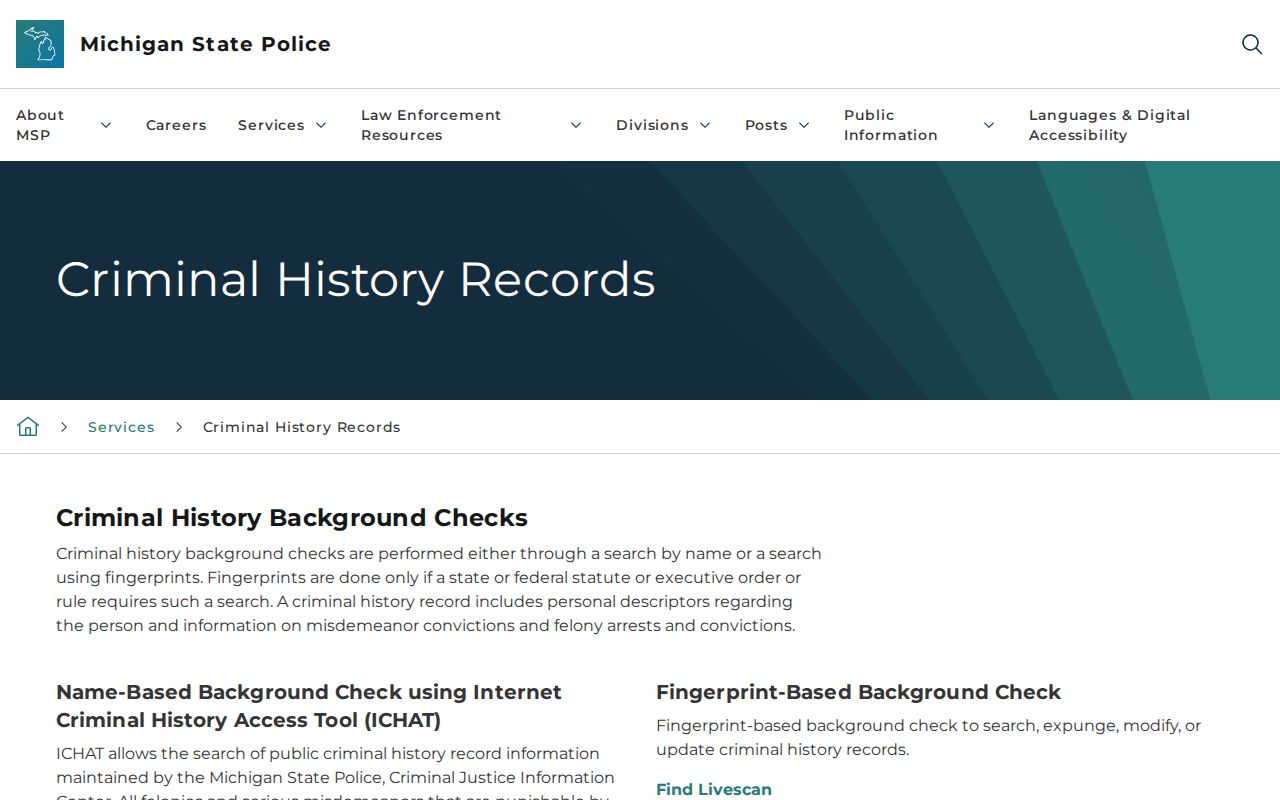
The MSP comparison makes the scope difference clear before a user pays for a search.
For one's own Clinton County criminal history, the biometric review is the better tool for finding repository entries tied to submitted prints. MSP also explains how to challenge or update errors. A court-originated mistake may require a certified disposition from the Clinton clerk, while an arresting-agency error may need records from the agency that contributed it.
The MSP self-review instructions identify the current documents and correction route.
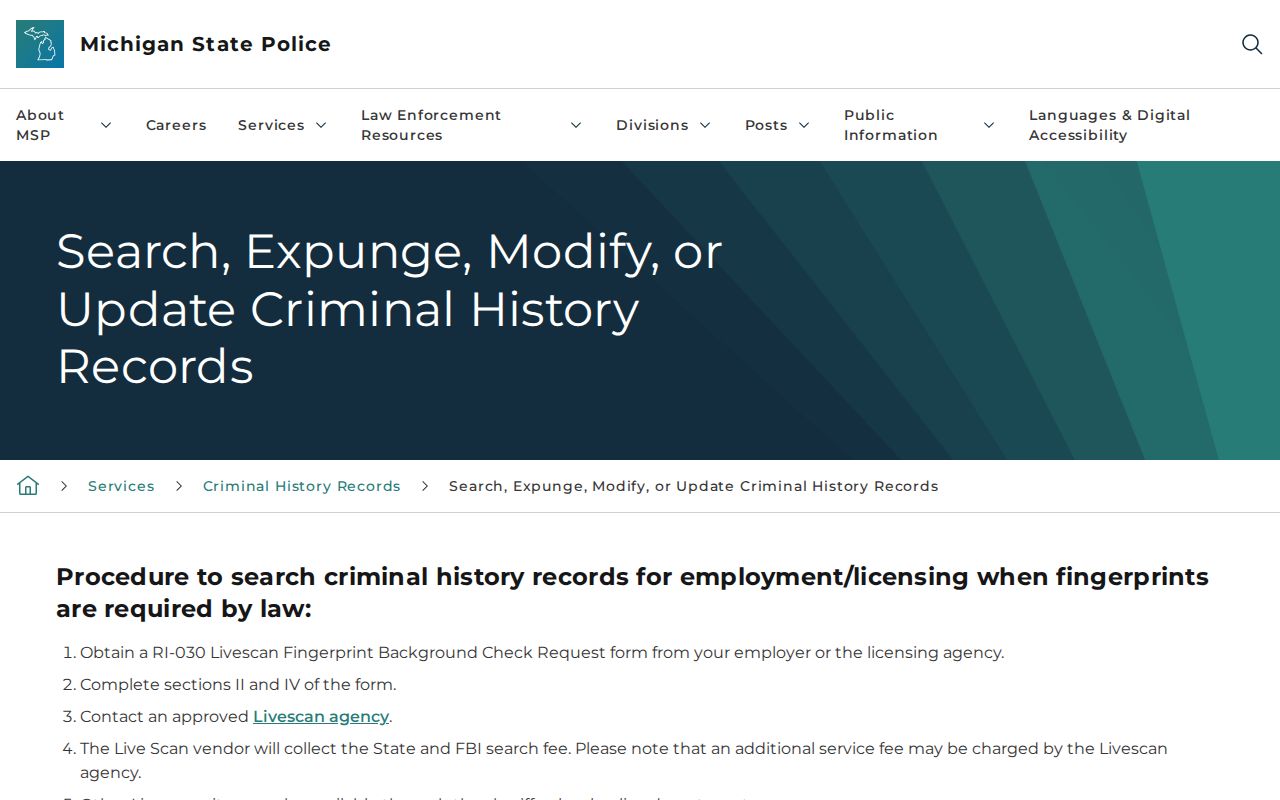
That source should be checked again before mailing because forms and processing directions can change.
Criminal Record Types
Clinton County criminal records describe separate points in a case. Police create incident and arrest reports. Jail staff create booking and custody entries. The prosecutor decides which complaint to authorize. Courts keep the filed case and disposition. MSP receives qualifying fingerprint and court reports, while MDOC creates a custody or supervision profile after an eligible sentence. The Michigan Public Sex Offender Registry is a separate registration system.
- Incident and arrest reports: agency accounts of an alleged event and the basis for custody.
- Booking records: jail intake, charge, bond, and release data.
- Court files: complaints, motions, pleas, judgments, sentences, and dismissals.
- Repository entries: reportable fingerprint and disposition events held by MSP.
- Custody and registry records: OTIS supervision data and PSOR registration profiles.
These records should not be treated as copies of one another. A booking charge can change before the prosecutor files a case, and a filed count can change again before judgment.
Clinton Records at Two Buildings
A common Clinton County records mistake is starting at the wrong building. The courthouse complex at 100 E. State Street holds the County Clerk, 65A District Court, and 29th Circuit Court. It is the place for filed cases and certified judgments. The Sheriff and jail at 1347 E. Townsend Road hold sheriff reports and booking material. A police narrative does not become a complete court file, and the jail cannot certify a final judgment.
Clinton County Courts
100 E. State Street, St. Johns, MI 48879
County Clerk: 989-224-5140
65A Criminal: 989-224-5153
Sheriff and Jail
1347 E. Townsend Road, St. Johns, MI 48879
Sheriff: 989-224-5200
Inmate inquiry: 989-403-5090
The official Sheriff page routes readers to jail, fingerprint, and public-record services.
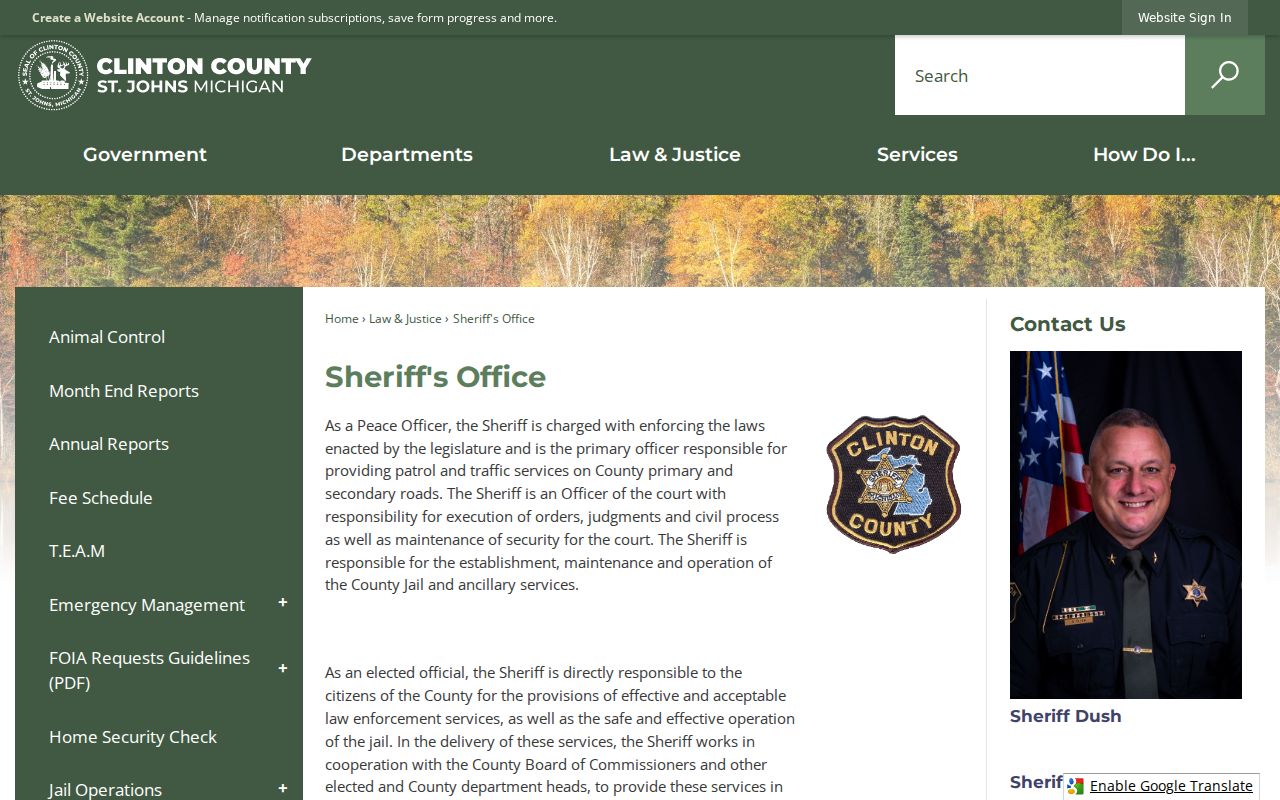
Its service links show why sheriff material has a separate access path from court records.
Inside a Clinton County Criminal Record
The fields depend on the record source. A public MSP result can include identity descriptors, a reportable arrest cycle, contributing agency, charge, court, disposition, and sentence data. A court register can add filing dates, judge, hearings, motions, bond, plea, and judgment. Sensitive identifiers are limited. Victim names, juvenile details, medical information, and protected addresses may be redacted or absent.
| Name and identifiers | Current or prior names, birth data, and public descriptors used to distinguish records. |
|---|---|
| Arrest and booking data | Agency, arrest date, booking time, charge at intake, bond, and custody status where released. |
| Charges and statutes | The alleged or filed offense and its Michigan citation. |
| Disposition | Dismissal, plea, verdict, or other final action reported by the court. |
| Sentence | Jail, prison, probation, fines, costs, or other terms in the judgment. |
| Supervision status | MDOC custody, parole, or felony-probation details when OTIS covers the person. |
Reporting gaps can occur. For a public reader, the most recent court disposition is the best place to learn how a Clinton County charge ended. For the subject of the record, compare a fingerprint review with certified court documents before asking MSP to correct the repository.
Clinton Court Records Before 1996
July 1996 divides Clinton Circuit access. Records after that point are available online, in person, or by mail. Earlier files can be searched at the clerk counter without a search fee. A mailed name search costs $10 per name for each ten-year span and requires a written request, a self-addressed stamped envelope, and payment to Clinton County Clerk. Copies cost $2 per page for the first ten pages in a case and $0.50 per page after that. Certified copies are listed at $1 per page plus $10.
The cutoff matters when MiCOURT returns nothing. It can mean the file predates online coverage, the wrong court was chosen, or the case moved from District to Circuit under a new number. Call the clerk at 989-224-5257 for the page count before using GovPay, which requires a case number and adds processor charges.
Public Access Laws in Michigan
The Michigan Freedom of Information Act covers executive-branch public records, including many agency-created police records, subject to exemptions. Court files follow judicial access rules instead of treating the clerk as an ordinary FOIA office. A public docket is informational. A certified copy from the clerk is the formal court record. Restrictions can protect an active investigation, juveniles, victims, private identifiers, confidential sources, security methods, and other nonpublic material.
Key Statutes:
MCL 15.231 states Michigan's policy favoring access to public business.
MCL 15.233 permits inspection or copies of sufficiently described public records.
MCL 15.235 sets the general five-business-day response framework and one extension.
MCL 15.243 lists exemptions that can protect law-enforcement and private material.
MCL 780.621 begins Michigan's conviction set-aside eligibility rules.
Availability does not prove that an allegation is true. The court disposition must still be checked.
Clinton Criminal Records by FOIA
Clinton County uses a central FOIA page rather than a stand-alone commercial portal. Direct the request to the office that created the record. Ask the Sheriff for a sheriff incident or booking sheet. Ask Central Dispatch for a CAD log or 911 recording. Use the clerk's court-record route for pleadings, orders, registers, and judgments.
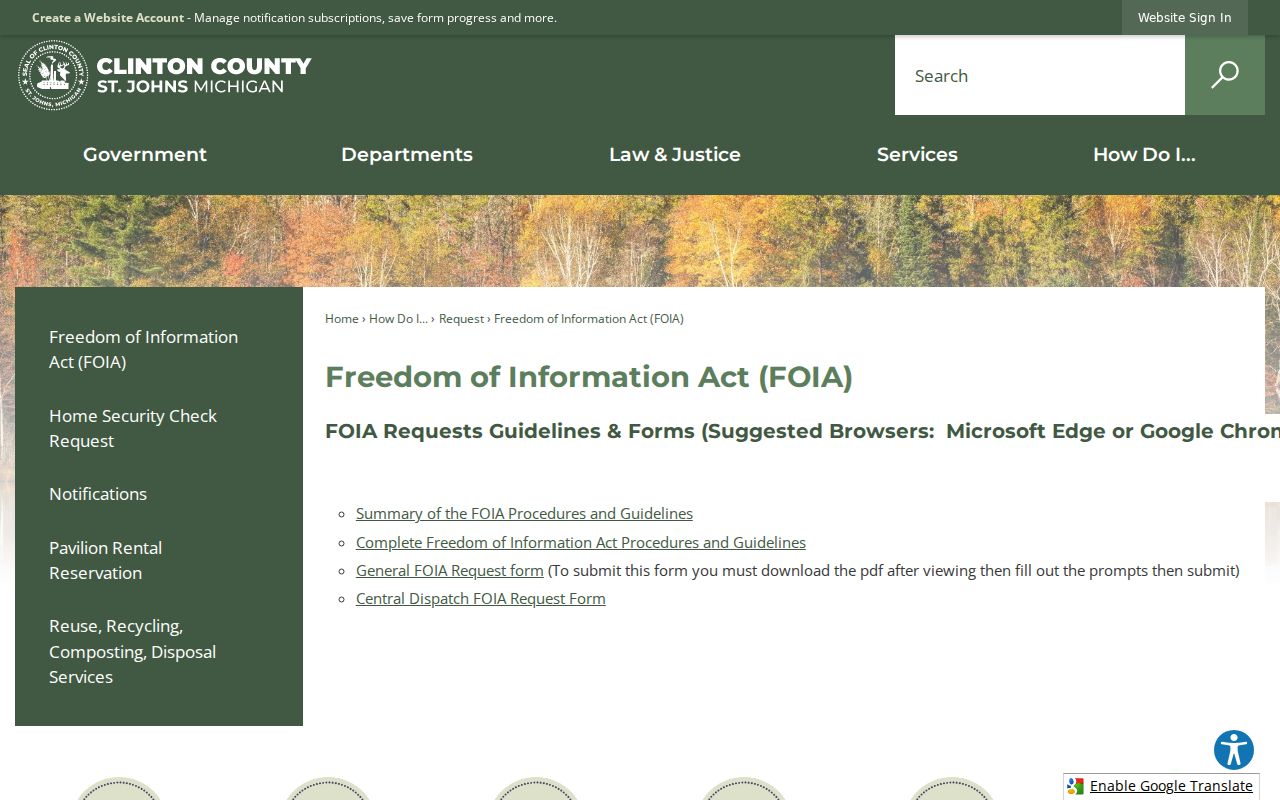
The county page links both the general request form and a separate form for E 9-1-1 and Central Dispatch material.
A narrow request should state the incident date, time, place, agency, report or CAD number, and each exact item wanted. Under state law, the county generally responds within five business days by granting, denying, partly granting, issuing a fee notice, or taking one extension of up to ten business days. A response date is not always the date records will be produced. The county form may require a half deposit when an estimate exceeds $50.
Sealed, Expunged, and Restricted Records
Michigan calls conviction relief “setting aside” a conviction, though expungement is a common term. MCL 780.621, 780.621c, 780.621d, and 780.621g govern limits, excluded offenses, waiting periods, and automatic Clean Slate relief. The rules do not reduce to one waiting period. The number and type of convictions, the offense, sentence completion, and other statutory events affect eligibility.
A Clinton County application begins in the court of conviction. The applicant should use the current SCAO packet, obtain the required certified record and fingerprints, serve the named agencies, and attend any hearing. A set-aside can remove a conviction from normal public display, but it does not make every independently held police record or old publication vanish.
The county's conviction set-aside page provides the local filing orientation and forms. Current instructions should control because forms and processing charges can change.
Clinton Jail Records Versus OTIS
The county jail and OTIS cover different levels of custody. Clinton County's jail holds local pretrial detainees and many jail sentences. Call the inmate-inquiry line or use the official Sheriff route for current custody. OTIS begins with MDOC prisoners, parolees, felony probationers, and usually people discharged from supervision within three years. It excludes jail-only sentences and people not yet sentenced.
The MDOC OTIS interface accepts an MDOC number or name and allows other filters.
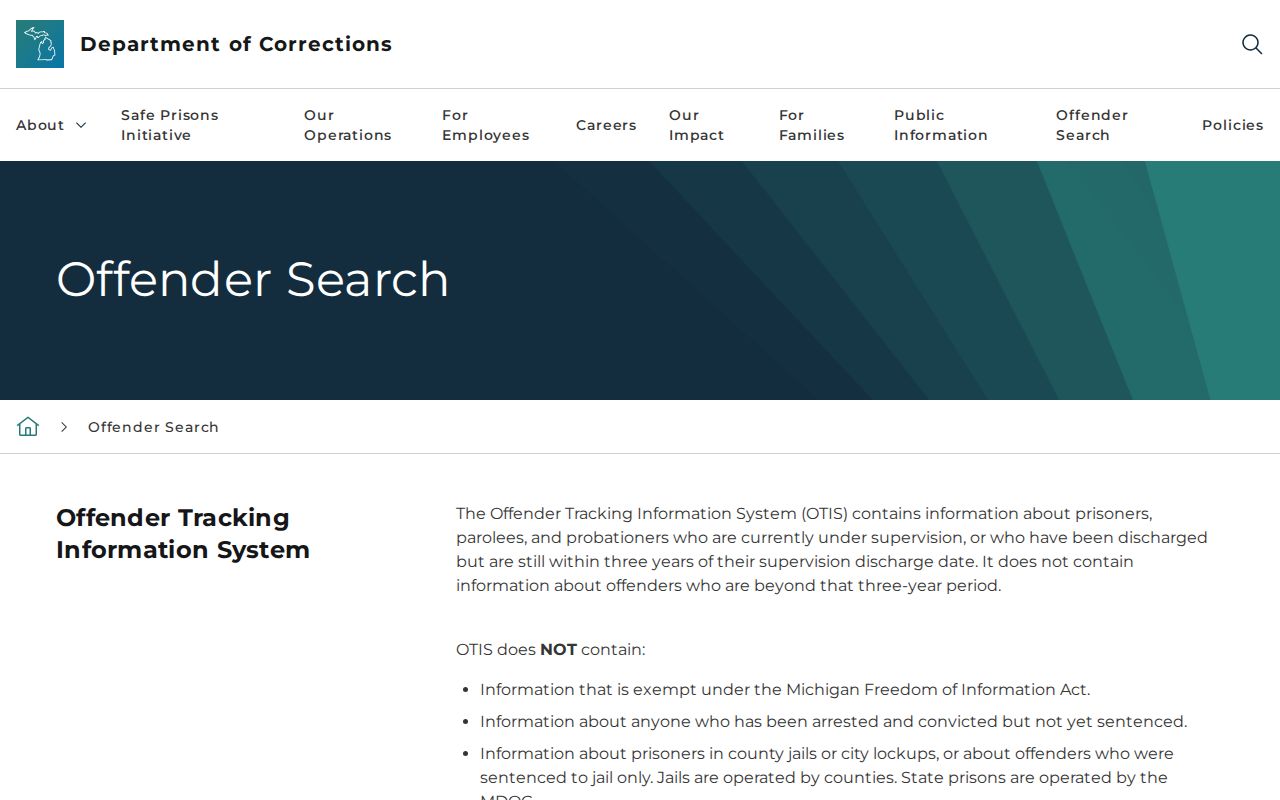
An OTIS location link can identify a prison or supervision office, but the result is not a complete background check.
Clinton County falls in MDOC Region 7 with Eaton and Ingham Counties. The MDOC field-office directory supplies the current supervision contacts.
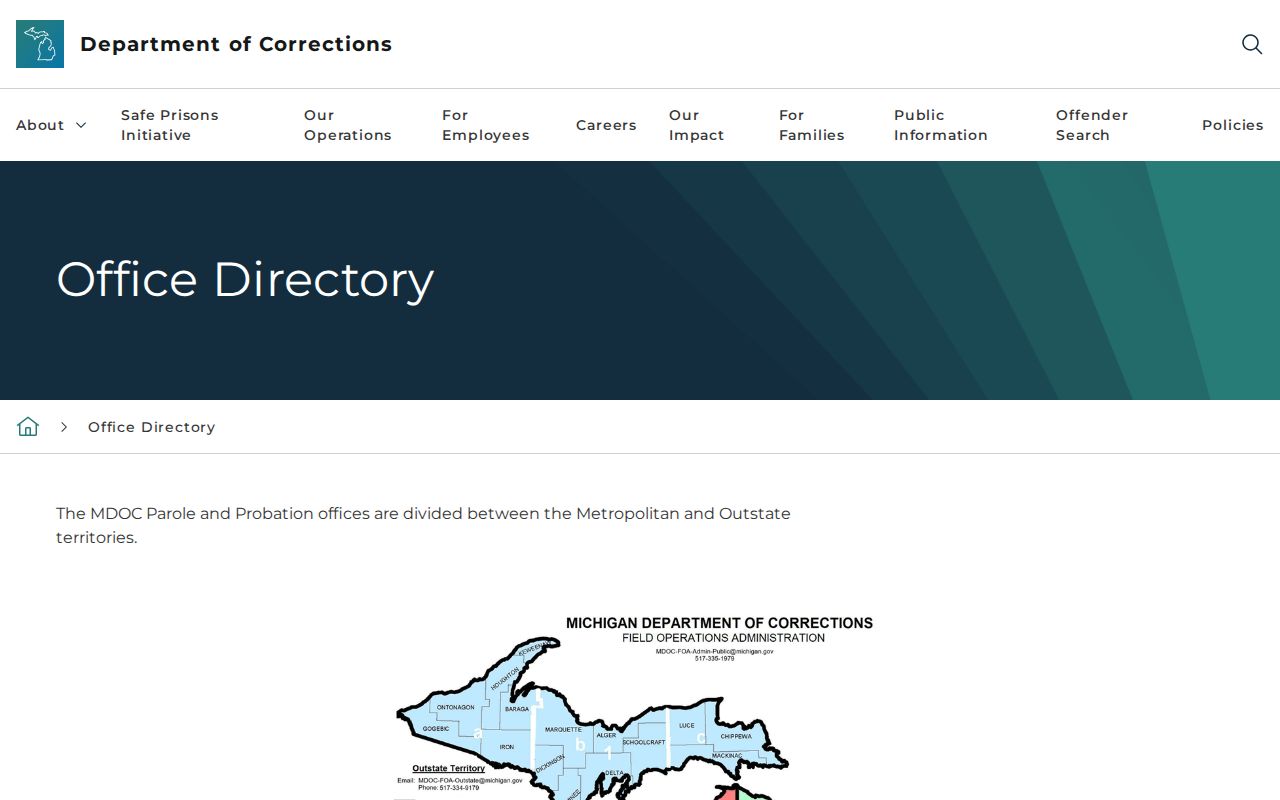
The sentencing court remains the best source for the judgment and probation order that created supervision.
Clinton County Warrant Record Checks
No authoritative countywide public warrant search was found on Clinton County's official pages. That does not make a possible warrant impossible to check. A person resolving their own District Court warrant can call the 65A Criminal Division at 989-224-5153. A Circuit warrant after bindover or a probation event belongs with the County Clerk or Circuit assignment office. Sheriff execution questions use 989-224-5200.
ICHAT is not a warrant search, and LEIN is a law-enforcement system rather than a public portal. Ask the issuing court what its docket shows, obtain the case number, follow the authorized appearance or payment instructions, keep the order or receipt, and confirm that recall has posted. Do not rely on an unsolicited caller or stale list when liberty is at risk.
Federal Records Beyond Clinton County
Federal criminal cases from Clinton County belong to the U.S. District Court for the Western District of Michigan, not MiCOURT or the County Clerk. PACER is the federal docket source and requires an account. The Bureau of Prisons locator covers federal custody, not the Clinton jail or MDOC.
The Western District of Michigan site identifies the federal court serving Clinton County.
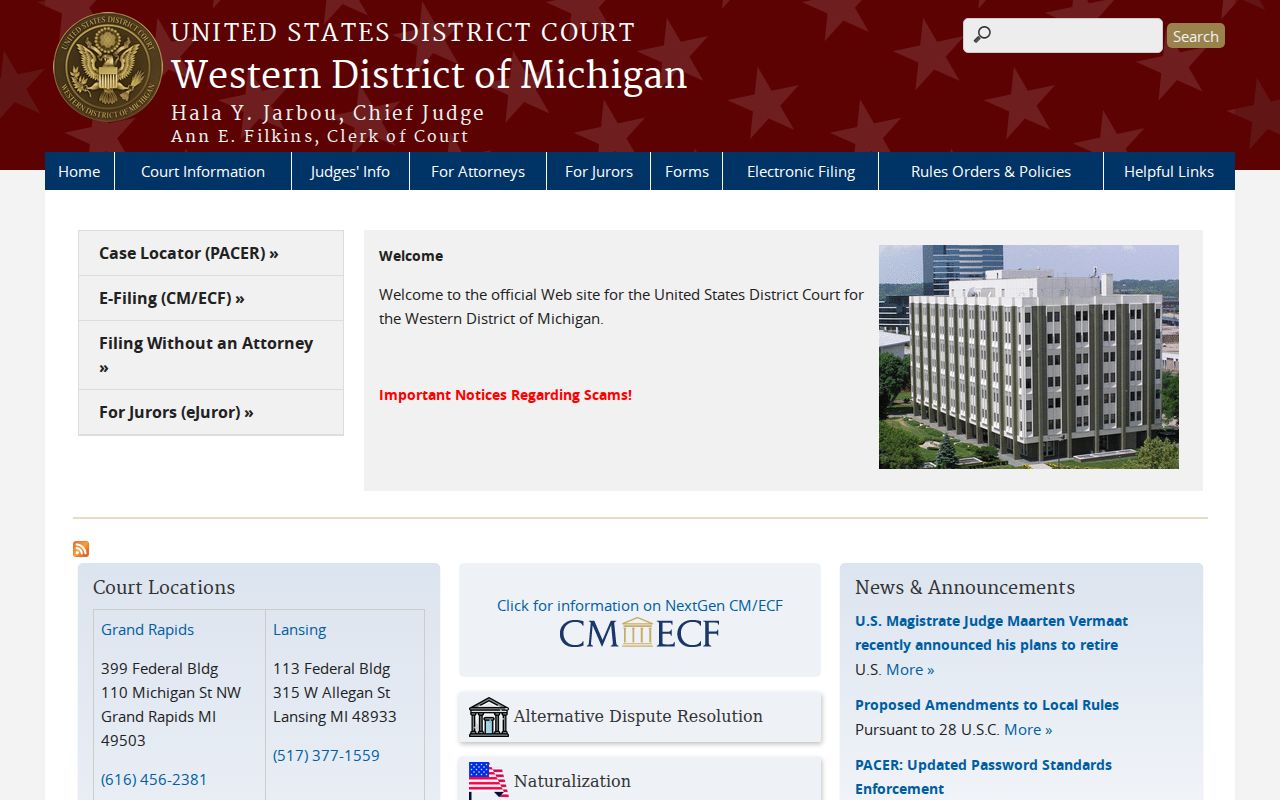
A federal search is useful only when the matter actually falls within federal jurisdiction.
Clinton Criminal Records Under One Roof
The current courthouse brought several record holders together at State Street. The five-story, 117,000-square-foot building was dedicated in 2000 after limits at the old courthouse. Its third floor houses 65A District Court, probation, and the Prosecuting Attorney. Circuit, Probate, Juvenile, and Friend of Court functions occupy the fourth floor. The County Clerk is in the same complex, which makes it possible to move from a preliminary District file to a bound-over Circuit file without treating them as one case number.
The county's new courthouse history explains the project and salvaged features from the earlier building.
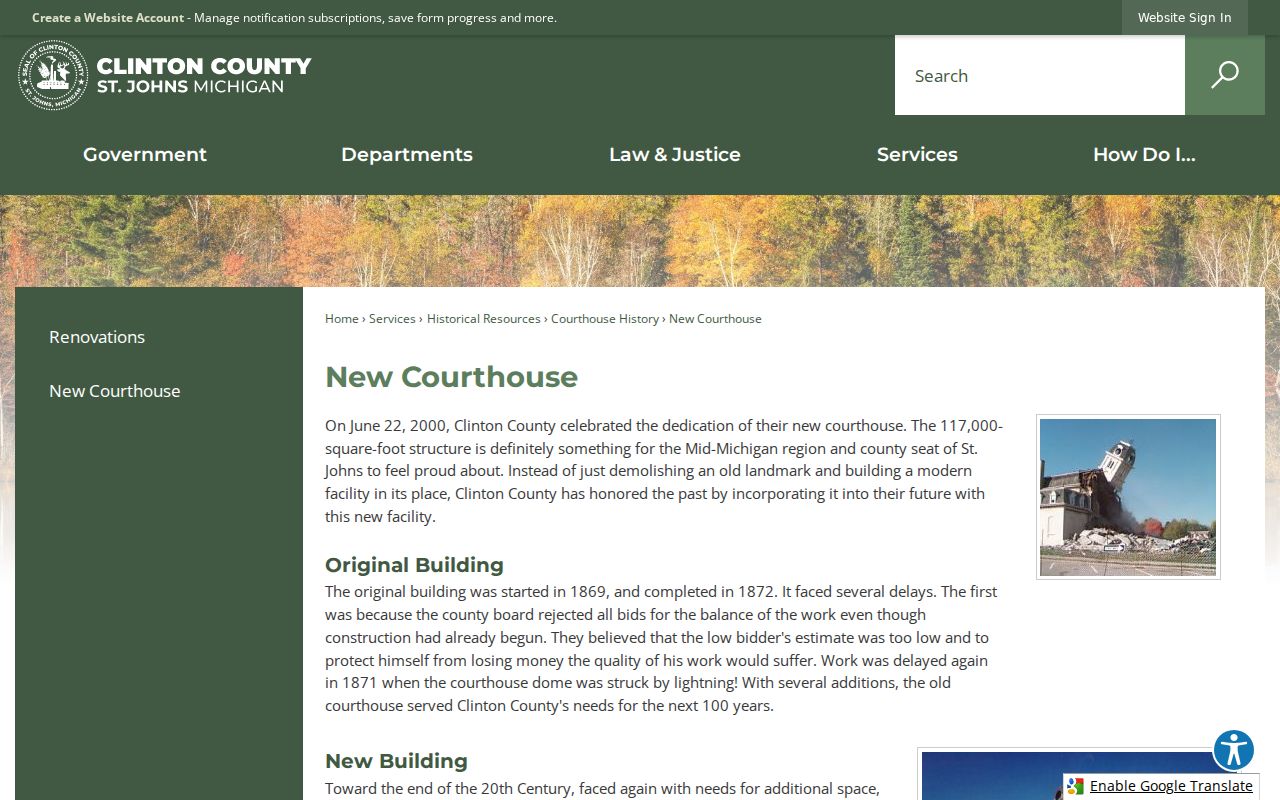
The building layout mirrors the county's record flow: District proceedings begin the felony trail, while Circuit holds the case after bindover.
Clinton County Criminal Records by City
City police departments create their own incident and arrest reports, while court and custody routes can cross city and county lines. St. Johns matters as the county seat. DeWitt has its own police channel and must not be confused with DeWitt Township. East Lansing crosses the Clinton and Ingham boundary, so the incident location, arresting agency, and court number control the correct court route.
St. Johns Criminal Records
County seat · Police reports begin with St. Johns PD; state criminal cases use 65A and 29th Circuit.
DeWitt Criminal Records
City police jurisdiction · DeWitt reports, county jail custody, and Clinton court files have distinct routes.
East Lansing Criminal Records
Cross-county city · ELPD and 54B records require boundary-aware routing.