
Checking Criminal History in East Lansing
Start with the record that answers the question. The East Lansing Police Department keeps its own incident, arrest, and video material. The 54B District Court keeps the public case register, filings, orders, and misdemeanor outcomes within its jurisdiction. A felony may begin in District Court, then move to Ingham County’s 30th Circuit Court after bindover. “Bindover” means that the District Court has sent a felony forward for Circuit Court proceedings. The Clinton County 29th Circuit should not be used just because an address lies north of the county line.
A sound East Lansing criminal records search uses these five steps:
- Identify the incident location, date, arresting agency, and any police report number. Those facts show which office created the first record.
- Request an incident or arrest report from ELPD Records through JustFOIA, the city PDF form, email, mail, fax, or pickup.
- Search MiCOURT under D54B by party name or a known case number. Read the court and case caption before relying on a match.
- For a felony, follow the court number into Ingham County’s 30th Circuit system after bindover. Check the named jail for present custody.
- Use Michigan ICHAT only when a public, name-based state repository result is useful. It does not replace the city report or court file.
The broader Clinton County criminal history overview is useful for records actually held by Clinton offices. It is not a reason to reroute an East Lansing file away from the court shown on its docket.
East Lansing Record Searches Cross Counties
East Lansing spans Ingham and Clinton Counties. The whole city had a July 2025 population estimate of 49,355, while the Clinton County part counted 2,477 people and 3.4 square miles in the 2020 Census. Those figures describe different geographic units. Neither tells a records requester which court owns one event. The incident site, police agency, and docket number do.
This boundary creates a common trap. A person may live in the Clinton County portion of East Lansing, yet an ELPD arrest or felony case can still follow the city’s published route through 54B District Court and Ingham County. Conversely, a separate event handled by a Clinton County agency should be traced through that agency and its court. Treat the mailing city as a clue, not a jurisdiction ruling.
Record-routing test: incident location › creating police agency › court shown on the complaint or MiCOURT result › county clerk holding the later file.
When two name matches look similar, compare case numbers, filing court, event dates, and charge history. Do not merge entries simply because both carry an East Lansing address.
East Lansing Police Department Records
ELPD Records is at 409 Park Lane, East Lansing, MI 48823. The office can be reached at 517-351-4220, option 5, by fax at 517-337-7372, or by email at foia@elpolice.com. Published counter hours are Monday through Friday, 8 a.m. to 4 p.m. The unit accepts requests through its online system and through a no-login PDF form. Email, mail, fax, and pickup are listed delivery routes.
The requester must give a complete name, a USPS-standard mailing address, and either a phone number or email. Add the incident date, place, report number, and exact record wanted whenever known. An active or open ELPD report is not released. That rule explains why a request may yield no copy while the investigation remains open, even though a later court docket is public.
The official East Lansing Police Records page shows the request routes and release terms.
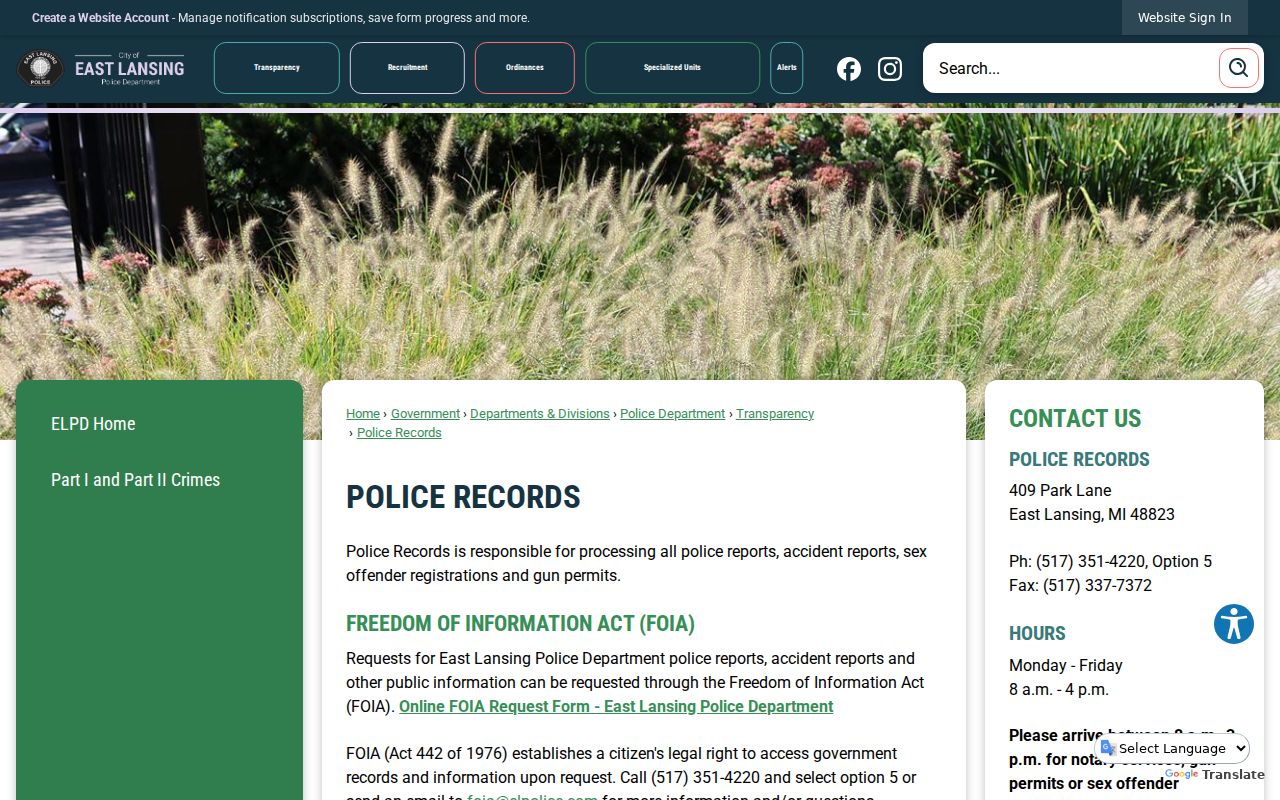
The captured records page is the right source for current ELPD contact details, request choices, and posted fee terms.
East Lansing JustFOIA Record Requests
East Lansing JustFOIA is the city police department’s online request channel. Current inspection sends users through a JavaScript-dependent sign-in flow using OAuth or SAML. A blocked script, strict browser setting, or sign-in problem can therefore stop the online route before the form appears. That is an interface issue, not proof that ELPD lacks the requested record.
The official police PDF provides the fallback. It asks for date, name, full address, phone, email, attorney-representation information, and a clear description of the record. Use that form by the delivery channel the Records Unit lists. A narrow request is easier to locate and price than a demand for all records tied to a broad name.
The posted schedule gives the first 30 minutes at no charge. It then lists search labor at $26.56 per hour, review and redaction at $85.45 per hour, paper at $0.05 per page, duplication labor at $29.25 per hour, DVD-R at $0.25, USB media at $4, plus actual media or postage costs. ELPD may seek a deposit. An unpaid request can be treated as abandoned after more than 45 days.
East Lansing Arrests and Bookings
An ELPD arrest can create several files at once. The officer and department create the incident and arrest reports. Custody staff create lockup entries and video. The prosecutor determines the charge to file. The court creates the arraignment, bond, hearing, and final disposition record. Those sources may use different wording because a booking allegation can be changed, rejected, or dismissed.
East Lansing differs from the other Clinton County city profiles because it documents a 72-hour police lockup staffed around the clock. The published policy describes felony prisoners being processed or lodged there. On weekends and holidays, transport can go to Lansing Jail. If bond is not posted, a transfer can follow to the Ingham County Jail. Do not assume that the Clinton County Jail on Townsend Road holds every person arrested in the Clinton-side part of East Lansing.
A recent arrest may show in a custody record before the court file is complete. The Clinton County arrest lookup covers the Clinton jail and sheriff routes, but ELPD and Ingham channels control the East Lansing path described here.
East Lansing Lockup to Ingham Records
For current custody, first ask where ELPD lodged or transferred the person. A stale city lockup answer does not rule out a later county transfer. The safest sequence is to confirm the arresting agency, call the correct custody office, and then search the court once arraignment data is posted. Weekends, holidays, bond decisions, and court availability can change the timing.
For the police narrative, ask ELPD. For jail booking details, ask the facility that logged the booking. For bond or charge status, read the 54B docket. After a felony bindover, check Ingham County’s 30th Circuit file for the later plea, motion, trial, judgment, or sentence. This chain respects each custodian’s role and keeps an early booking label from being mistaken for the final outcome.
Note: An arrest is an allegation, not proof of guilt; use the most recent court disposition to learn how the case ended.
Municipal Court Records in East Lansing
East Lansing does not use a separate municipal criminal court of the type found in some other states. The local trial court is 54B District Court at 101 Linden Street. Public case access uses MiCOURT’s D54B route. A requester may search online first, then ask the court for the register of actions, a complete public file, or named documents.
| Court Name | 54B District Court, East Lansing |
|---|---|
| Case Types Heard | District-level criminal and traffic matters, including misdemeanors and felony preliminary stages |
| Case Lookup Channel | MiCOURT D54B search, followed by a specific copy request to the court |
| What the Docket Shows | Case number, parties, register of actions, hearings, public filings, and case status as made available |
| Copies & Fees | Normally $1 per page; up to five copies within one hour, while stored files may take three business days |
The court cannot provide LEIN data, a driving record, or a criminal-history report. Those are different products. A MiCOURT screen also is not a certified copy. Ask the clerk for the formal document when proof of a judgment or order is needed.
East Lansing 54B Record Requests
A 54B copy request must identify a case number or a party name. The form asks for the date, requester name, address, contact number, case numbers, party names, and date of birth. It also lets the requester choose a register of actions, the complete public case file, or specific documents. “Complete” still excludes nonpublic material.
Use the case number when it is known. It avoids confusion between people with similar names and points the clerk to one file. If only a party name is available, give enough identifying detail for the clerk to locate the right docket without asking for protected personal data. Stored records can take longer than records ready at the counter.
The city’s 54B public court records instructions show the access and copy rules.
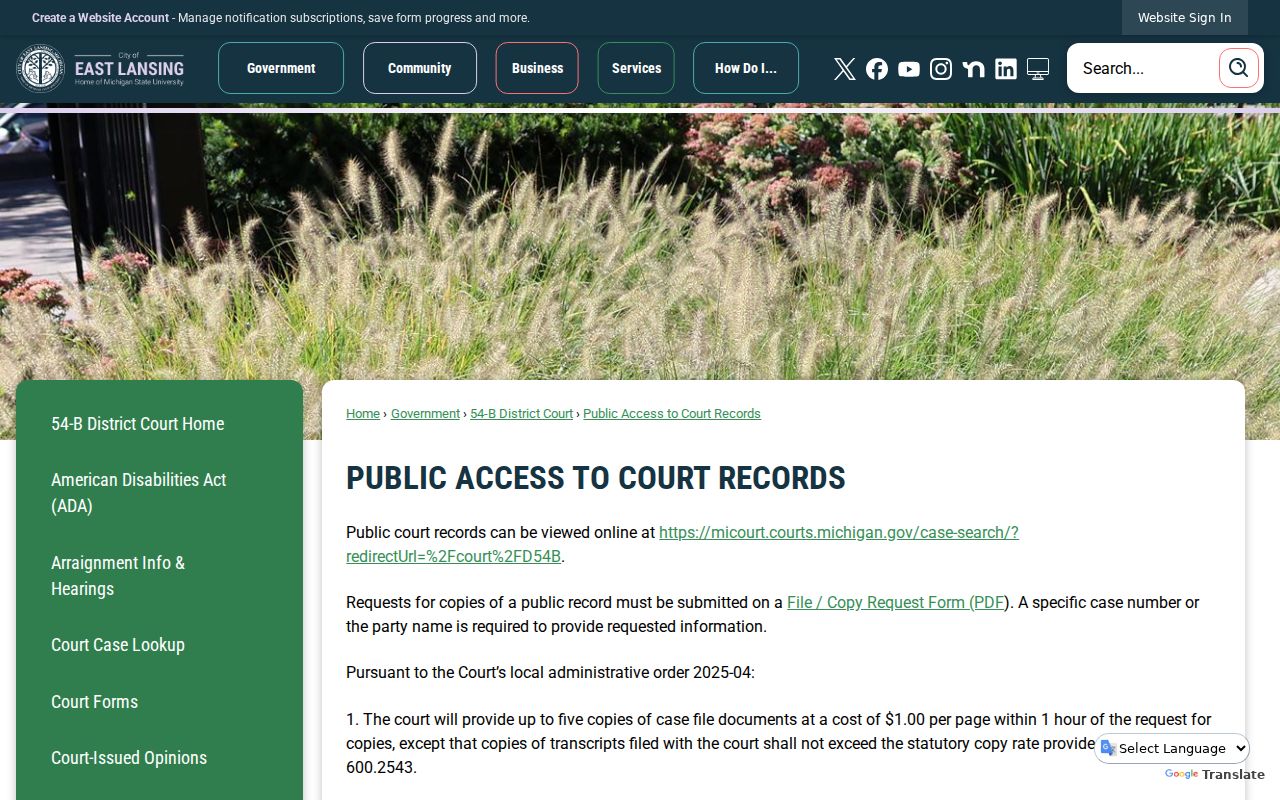
The court capture reinforces the key routing point: East Lansing case copies come from 54B by a specific case or party request, not from a broad police search.
Where East Lansing Records Go
ELPD keeps the report it created. The prosecutor and court build the criminal case. Qualifying fingerprint and disposition events then flow to the Michigan State Police Criminal Justice Information Center. Public ICHAT results show only the repository’s reportable Michigan subset. They exclude warrants, juvenile files, federal and tribal cases, traffic matters, local misdemeanors, other-state records, and suppressed entries.
Record flow: East Lansing Police Department › 54B District Court › Ingham County 30th Circuit after felony bindover › Michigan State Police CJIC.
This route is more accurate than the template assumption that every city case enters Clinton County courts. If an incident was handled by a different agency or court, follow that file’s real caption and number. The state repository is useful for a later public history layer, but it will not show every local police record or explain every case outcome.
Reading East Lansing Police Record Counts
The official 2024 response-to-resistance report counted 35,599 calls, or 28,345 when traffic and parking were excluded. It also reported 5,460 traffic stops, 1,080 Part I crimes, 1,196 Part II crimes, and 1,597 mental-health calls. These are agency-year activity measures. They are not conviction totals, and they do not state that every call produced a report, arrest, or court case.
Part I and Part II are reporting categories used to group types of offenses. They do not capture all police work. Calls for service include events that may involve no crime at all. Traffic stops can end without an arrest. Mental-health calls may require care and documentation without a criminal charge. A reader should use the counts to understand ELPD workload, then use the report and docket for one specific event.
The city’s Police Reports and Statistics hub is the source for annual and monthly publications. Always keep the report year and agency beside any number.
East Lansing Police Video Records
ELPD’s PDF form separates several video sources: Body Camera Primary Only, Fleet Car Camera Primary Only, Jail Booking, Jail Breath Room, and Any Other Camera. The last choice asks the requester to be specific. Those boxes matter because a written incident report and a video file are not the same record, and each can require a different search and redaction task.
State the date, time, place, officer or unit if known, report number, and exact camera source. Ask for the narrow clip or event needed. Video from a private space, footage involving victims or juveniles, medical content, active investigation material, and private identifiers may be withheld or redacted under Michigan law. The city can also charge for search, review, duplication, media, and postage under its schedule.
If ELPD denies or limits a video request, read the written reason. A public body should identify the legal basis for withholding. A requester can ask for segregable portions, meaning the parts that can be released after protected material is removed.
Public Access Rules in East Lansing
Michigan FOIA governs requests for ELPD public records. It gives a right to inspect or receive records held by a public body, subject to exemptions. A request must describe the material well enough for staff to locate it. The public body generally has five business days to grant, deny, grant in part, issue a fee notice, or take one permitted extension. That is a response framework, not a promise that every large record set will be produced in five days.
54B court records follow judicial access rules rather than treating the court clerk as an ordinary city FOIA office. Protected identifiers, victim information, juvenile material, and nonpublic court records stay limited. A docket is informational. A certified clerk copy is the formal record.
Key Statutes:
MCL 15.231 states Michigan’s policy of public access to government affairs and official acts.
MCL 15.233 permits inspection or copies when a request identifies the public record well enough to find it.
MCL 15.235 sets the response choices and timing framework for a written FOIA request.
MCL 15.243 lists exemptions that may protect active investigations, privacy, confidential sources, and safety-sensitive material.
Ask for a written explanation and statutory citation if material is withheld. Then compare the released police record with the court’s most recent disposition before drawing a conclusion about the East Lansing case.